Case Study
A patient-facing app designed to make health data clear and actionable
Timeline
7 Weeks
(Oct 27 - Dec 11 2025)
Role
Product Designer
Skills
UX Research
Interaction Design
Information Architecture
Data Visualisation
UI System Design
Prototyping
Tools
Figma
Project Overview
Parameter is a patient-facing genetic health app designed to reduce health data fragmentation. By centralizing daily health metrics and medical reports into a single, organized experience and layering in AI-powered explanations, Parameter helps users understand how their data connects over time and what it means for their health.
Design Challenge
How might we make health insights understandable and motivating so that users feel empowered to take proactive, preventative steps toward their well-being?
Goal/Opportunity
Design a trusted, patient-facing experience that centralizes health data and transforms complex information into clear, actionable insights users can understand and engage with over time.
Process
Deliver
Hi-fi Wireframes
Hi-fi Prototypes
Next Steps
Understanding the Problem
Health data is fragmented and difficult for patients to act on
Patients manage health information across lab portals, wearables, notes, spreadsheets, and paper records. While access to data has increased, patients often lack a clear way to understand how this information connects or what it means over time.
Medical results are frequently presented without context, making it difficult to interpret trends or translate data into action. As a result, many patients engage with their health data reactively, relying on appointments rather than building ongoing insight.
Without clarity, health data creates friction instead of empowerment.
Discover
User Interviews
I conducted semi-structured interviews with 7 participants, including patients and medical professionals, to understand how people currently manage health information and where breakdowns occur.
To capture a range of behaviors, I spoke with individuals who actively manage chronic conditions as well as those who engage with their health data more passively. Participants were kept anonymous to protect privacy, and questions avoided specific diagnoses to reduce discomfort.
Including clinicians allowed me to examine the problem from both the patient experience and the clinical perspective, particularly around access, interpretation, and communication of health data.
Interview Goals
Learn how patients track and manage their medical information across tools and systems
Identify the key challenges and concerns users encounter with digital medical apps
Understand the barriers patients and doctors experience in their interactions
Key Takeaways
1
Fragmented health data
Health information lives across disconnected tools.
2
Reactive engagement
Patients check data only when something feels wrong.
3
Difficulty acting on results
Results are accessible, but next steps are unclear.
4
Trust and privacy concerns
Unclear data use reduces trust in health apps.
5
Communication breakdown
Even simplified explanations don’t ensure understanding.
6
Need for centralized support
Users want one trusted place for clear, organized health information.
Discover
Competitive Research
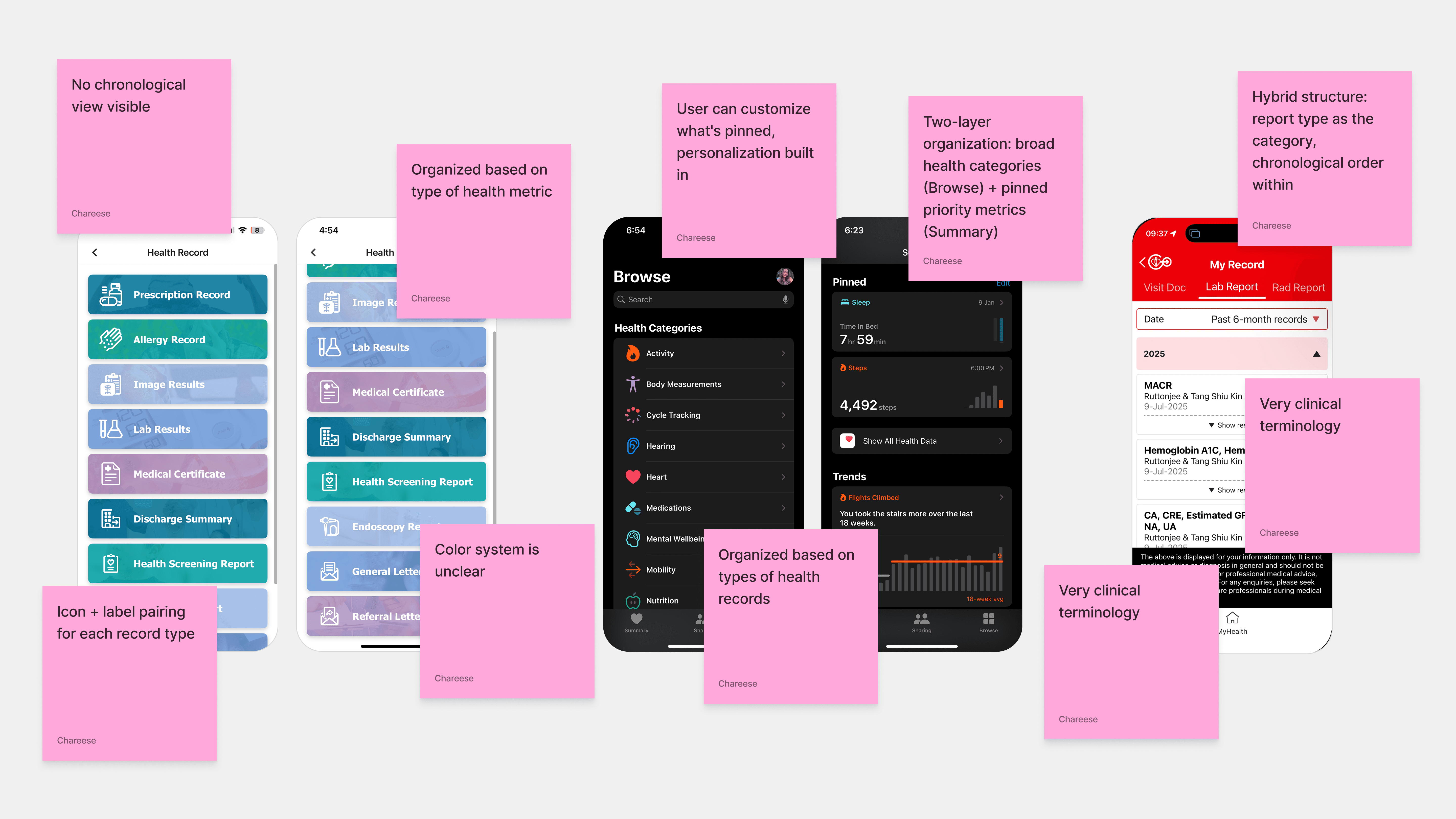
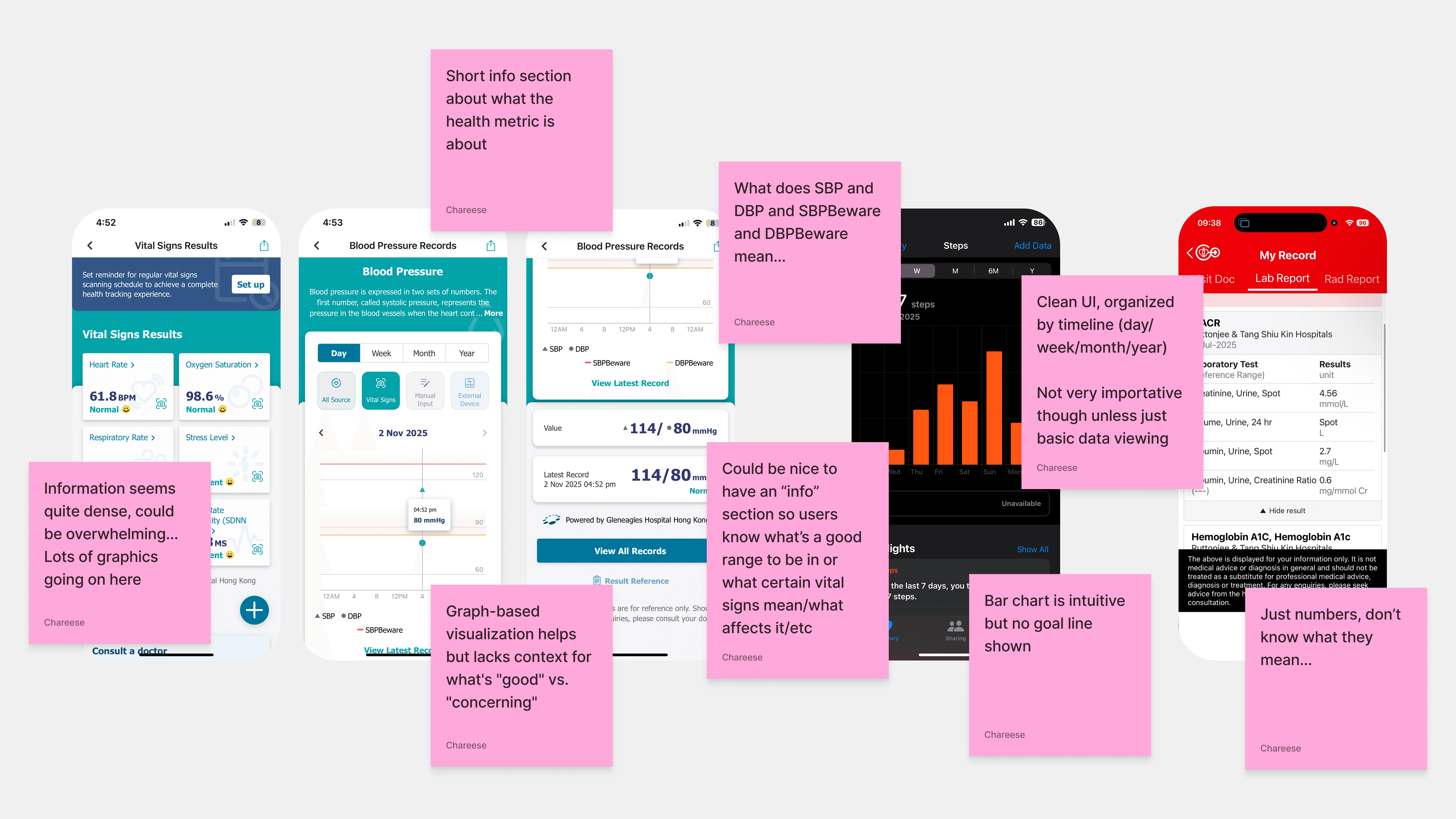
I analyzed habit tracking, productivity, and mentorship tools to identify how professional growth is currently supported and where key gaps exist for early-career professionals.
Existing tools support parts of professional growth, but none offer a unified system that connects habits, reflection, planning, and mentorship.
Feature comparison highlighting gaps in reflection and mentorship support
Key Insights & Opportunities
1
Personalized starting points
Guide early-career professionals through goal setting and habit creation with prompts and templates.
2
Accountability beyond streaks
Support consistency through mentor and peer accountability, not just reminders.
3
Reflection as a growth tool
Embed reflection into habits and milestones to connect effort with outcomes.
4
Centralized growth system
Unify habits, schedules, notes, and mentorship into one professional development system.
5
Flexible structure for long-term use
Balance guidance with adaptability so goals can evolve over time.
These insights directly informed Rise’s focus on habit-based tracking, reflection, and intentional mentorship within a single, structured system.
Define
Problem Statement
Early-career professionals want to grow intentionally, but lack clear systems to track progress, reflect, and stay accountable over time. Growth is often managed through fragmented tools and informal habits, making consistency difficult to maintain.
Early-career professionals need a structured system to consistently track, reflect on, and stay accountable for their professional growth.
Discover
Understanding the Problem
We began by analyzing the Arth website to uncover usability issues.
Home Page
Despite its minimalist design, unclear visual hierarchy and missing trust signals—like scientific credibility—made navigation and brand trust difficult. Inconsistent CTAs and flat product cards further affected clarity, shaping our redesign priorities.
Minimalist design
Lack of functional clarity
Lack of key information
Limited user trust due to lack of supporting information
Flat product cards and CTAs
Poor website design can undermine credibility
Product Listing & Product Details Page
The shop page lacks interactive states and robust filters, limiting product discovery. Text-heavy listings, inconsistent layouts, and missing details—like usage, sourcing, and purpose—make it hard for users to make informed decisions. These gaps reduce trust and hinder long-term engagement with the brand.
No filtering options
Makes product discovery feel limited
Inconsistent card layouts
Visually disrupts the shopping experience, leading to difficulty in building trust
Lacks key details
Limited usage instructions, ingredient information and purpose
All in all, our research uncovered six core challenges that shaped our design priorities:
Lack of trust and scientific credibility, leaving users uncertain about product effectiveness
Inconsistent visual design that didn’t align with the brand’s calming, holistic identity
Unintuitive product discovery, making it difficult for users to navigate and explore
Minimal guidance throughout the browsing and purchasing experience
Unclear brand story, weakening emotional connection and user engagement
Dense, jargon-heavy content that overwhelmed rather than informed
These insights formed the foundation of our redesign strategy, guiding every decision we made to create a more trustworthy, user-friendly, and emotionally resonant experience.
Discover
Competitive Research
To understand Arth’s place in the wellness space, we analyzed competitors like RootsLab, Goop, Hims, Thesis, and Thirty Madison. Each offered unique approaches to trust, education, and branding, helping us identify best practices and areas where Arth could stand out.
At the time, Arth’s site lacked common wellness features like quizzes, refills, or educational layers—but we saw this as a strategic opportunity. Starting fresh allowed us to design intentionally, aligning every feature with Arth’s identity: science-backed, tradition-rooted, and user-centered.
Product refill & delivery


Personalized treatment


UGC


Physiology/Constitution quiz


Product education


Science-backed


Key Insights & Opportunities
Personalized Onboarding
Constitution-based quizzes (like those used by Hims and Thirty Madison) could help Arth deliver tailored product recommendations rooted in Ayurvedic tradition.Trust Through UGC & Science
UGC with real people and peer-reviewed claims builds credibility. For Arth, blending testimonials with research-backed benefits strengthens trust.Transparent Ingredients
Users expect clarity. Brands like Goop and Thesis demystify ingredients. Arth can go further—creating an immersive, narrative-rich system around ingredient sourcing and efficacy.Retention via Subscription
Subscription models foster consistency. A goal-oriented, customizable flow for Arth could improve retention and reinforce daily wellness habits.Clinically Backed Claims
“Natural” isn’t enough—users want proof. Highlighting clinical studies and ingredient validation elevates Arth’s credibility.
Our Goal
Redesign Arth’s website to establish a trusted, distinctive, and conversion-friendly wellness experience
Bringing everything together—from research insights to competitive gaps—we defined a clear goal for the redesign:
To create a trusted, distinctive, and conversion-friendly wellness experience for Arth.
This meant not just refreshing the visuals, but also reinforcing credibility, simplifying discovery, and aligning the site with how users actually browse, learn, and make decisions.
Discover
User Interviews
We conducted interviews with 8 users to gain deeper insight into their needs, expectations, and decision-making processes.


Key themes emerged: users want clear, science-backed content over vague claims; they seek guidance through quizzes or starting points; and they associate clean, inclusive design with trust and credibility.
✓
Clear info builds trust
Users want clear, science-backed information and messaging, not vague wellness claims.
✓
Guidance helps decisions
Most users didn’t know what they needed right away—they looked for quizzes, suggestions, or quick-entry tools.
✓
Design affects credibility
Users interpret design tone as legitimacy. Clean, calm, and inclusive interfaces build emotional trust.
Key Insights
"I trust wellness products that show real proof."
“I want to know who’s behind it — not just some faceless label.”
“I’d rather hear from real people who’ve tried it than read a sales page.”
“I need someone to translate the clinical jargon — I just want to know what it does.”
Define
Problem Statement
What users are asking for is simple—but not easy:
A way to make decisions that feel clear, evidence-backed, and personally relevant. They want to trust what they're taking, and understand why it works for them—not just follow trends or vague promises.
Our goal with Arth is to remove the friction between intent and action—to empower users to engage in wellness in a way that feels grounded, confident, and aligned with their individual needs.
Users need a way to make confident, informed wellness choices tailored to their needs—without confusion or mistrust.
Define
User Persona
Persona 1
Julia represents a wellness-curious user who's motivated but overwhelmed. She wants to improve her health proactively, but finds it hard to know where to start. Her biggest pain points include fragmented information, unclear product benefits, and difficulty applying traditional wellness concepts like Ayurveda in modern life. She’s also time-poor, so she’s easily turned off by jargon, cluttered UI, or brands that lack transparency. What she needs is a clear, credible, and approachable entry point into wellness that matches her lifestyle and learning pace.

Julia, 34
“The Wellness Explorer”
Behavior
Practices yoga and light strength training weekly
Shops at natural grocery stores and reads product labels
Skims wellness blogs and listens to health-focused podcasts
Tries digital tools for sleep, mindfulness, or stress
“I’m interested in holistic health, but I don’t always know where to start.”
Goals
Maintain energy and focus throughout the workday
Build consistent, realistic wellness routines
Prevent burnout and stay ahead of health issues
Frustrations
Overwhelmed by scattered wellness advice
Many wellness brands feel too clinical or overly spiritual
Limited time to research ingredients and routines
Needs
Simple, modern guidance rooted in Ayurveda
Product and lifestyle-based recommendations
A platform that feels credible, caring, and aesthetic
Persona 2
Zara represents users managing chronic conditions with limited energy. Her wellness routine is focused on maintaining balance and avoiding flare-ups—not chasing peak performance. Her key pain points are around energy overload: she’s easily fatigued by complex navigation, dense content, and interfaces that demand too much effort. She also struggles with unclear ingredient information and a lack of inclusive, supportive tone in many wellness brands. What she needs is a platform that’s gentle, accessible, and low-friction, helping her make informed decisions without cognitive or emotional strain.

Zara, 30
“The Mindful Maintainer"
Behavior
Manages symptoms, seeks low-energy wellness tools
Freelance writer managing chronic conditions, values calm, inclusive design
"Some days I can write for hours. Other days, brushing my teeth feels like a marathon."
Goals
Conserve energy while managing symptoms
Feel in control of her wellness routine
Find truly supportive, low-effort solutions
Frustrations
Overwhelmed by cluttered UI or fast-paced marketing
Lacks clear ingredient or benefit explanations
Feels excluded by “performative” wellness platforms
Needs
Easy navigation and digestible content
Inclusive tone and accessible product info
Real human support without high demand on her energy
Define
How Might We…
From there, we identified key user challenges and framed them as HMWs. Julia, our user, is curious but overwhelmed—she wants to explore wellness but doesn’t know where to start. This led us to ask:
How Might We…
provide a gentle and intuitive starting point for users new to personalized wellness
make traditional wellness concepts like Ayurveda more approachable and practical for modern routines
guide users toward trusted choices without overwhelming them with too much information
for Julia?
On the other hand, Zara is managing chronic issues and needs wellness tools that support her without adding strain.
How Might We…
create low-effort wellness experiences that support users with fluctuating energy levels
simplify complex wellness information so it’s accessible in moments of cognitive fatigue
design inclusive, non-performative wellness platforms that adapt to the user—not the other way around
for Zara?
Define
Site Map
We streamlined the primary navigation into six clear entry points, aligning it with common user decision-making flows.
Within Shop, users can browse by best sellers, benefits, product type, or curated sets—offering flexible paths based on preference and intent.
A key addition is Find Your Solution: a 5-minute quiz that personalizes onboarding, builds user confidence, and drives tailored recommendations, enhancing both guidance and conversion.
Develop
Sketches
After aligning on key insights, we sketched independently to explore layout ideas for key pages—homepage, science, product listing, quiz flow, and PDP.
We then defined the content strategy for each:
Homepage: Clear CTA, best sellers, mission intro, and ingredient highlights
Science Page: Trust-building through formulation breakdowns, ingredient transparency, and linked research
Product Listing: Usability-focused with filters, quiz access, and credibility cues
These sketches fleshed out the full user experience, from education to purchase, ensuring that every step of the journey felt intuitive, informative, and brand-aligned.
Product Detail Page: Designed for flexibility with variant selection, expandable info panels, and recommended pairings to encourage discovery.
About Page: Structured around mission, team, and sourcing to build trust and emotional connection.
Quiz Flow: Prioritized simplicity with clear questions, clean layout, and a visual progress bar for orientation.
Develop
Lo-fi Wireframes
We began with a content-first approach to ensure key information was clearly structured. Once the foundation was in place, we layered in Arth’s personality through visual design, layout, and subtle interactions.
The progression, from wireframes to high-fidelity, shows how we balanced clarity with brand expression to create an engaging, exploratory homepage.
While the homepage prioritized storytelling, the science page focused on credibility. We structured complex topics—like formulation, ingredients, and research—into clear, digestible sections.
Iterations refined layout and interactions to guide users smoothly through the content without overwhelm. Visual data and stats added weight, making the science feel both approachable and evidence-backed. The result: a page that informs, builds trust, and keeps users engaged.
Develop
Usability Testing
To validate our design decisions, we ran usability testing with six participants.
We gave them two tasks:
Find the Premium Gold Turmeric product page
Learn about ingredients on the Science Page
Task 1 saw a 100% success rate with minimal friction. However, Task 2 revealed a gap: 60% found the Science Page directly, while 40% took extra steps, indicating that the content was useful but not always easy to find.
We used this feedback to improve navigation labels, page hierarchy, and the visibility of science-related content—making the experience more intuitive and accessible.
Develop
Style Guide
Post-testing, we applied Arth’s visual system using their detailed style guide to ensure cohesion and intention across the design.
The brand’s soft, modern aesthetic featured a refined color palette, serif-sans typography, and thoughtful spacing. We followed specific rules—like sentence case headings with italicized prepositions and a 70/30 white space-to-color ratio—to create clarity, rhythm, and balance.
These elements came together to deliver a calm, cohesive experience aligned with Arth’s identity.
Colors
#ECEFFF
#D9DEFF
#C6CEFF
#B3BEFF
#F6FAEC
#EDF4D8
#E5EFC5
#DCEAB2
#FFFFFF
#FAF7F2
#EFE9DC
#E5DFD2
Typography
GT Alpina Trial
Thin
Light
Regular
Medium
Semibold
Bold
ExtraBold
Black
Thin Italicized
Light Italicized
Regular Italicized
Medium Italicized
Semibold Italicized
Bold Italicized
ExtraBold Italicized
Black Italicized
DM Sans
Thin
Extra Light
Light
Regular
Medium
Semibold
Bold
ExtraBold
Black
Thin Italicized
Extra Light Italicized
Light Italicized
Regular Italicized
Medium Italicized
Semibold Italicized
Bold Italicized
ExtraBold Italicized
Black Italicized
Logos and Color Pairings
Deliver
Hi-fi Prototype
Reflection
My Experience
During my UX Bootcamp at General Assembly, I had the opportunity to collaborate with Arth, a wellness brand focused on holistic health, as a real-world client. This experience offered a valuable introduction to client-designer dynamics and taught me how to balance creative autonomy with stakeholder expectations. From our initial meetings, it became clear that clear communication, active listening, and aligning on priorities were just as important as good design.
Working with Arth challenged me to think critically about designing for a wellness audience—specifically, how to present educational content in a way that feels trustworthy while supporting a seamless e-commerce experience. Through user interviews and usability testing, we uncovered key pain points around product discovery and user trust. Users were often overwhelmed by jargon or unsure about the efficacy of the products, so we focused on simplifying content and building credibility through clean, transparent design. I translated those insights into intuitive user flows, accessible UI patterns, and visual design choices that reflected Arth’s calming, holistic brand. It was rewarding to see how these thoughtful design decisions could not only improve the shopping experience but also foster user confidence in making informed health decisions.
Collaborating with a client in a fast-paced, iterative environment sharpened my communication and project management skills. I learned how to present design rationales clearly, adapt to feedback constructively, and advocate for user needs while still supporting business goals. Overall, the project reaffirmed my belief in the power of user-centered design and gave me a strong foundation for future client-based work.
All rights reserved | Copyright © 2026